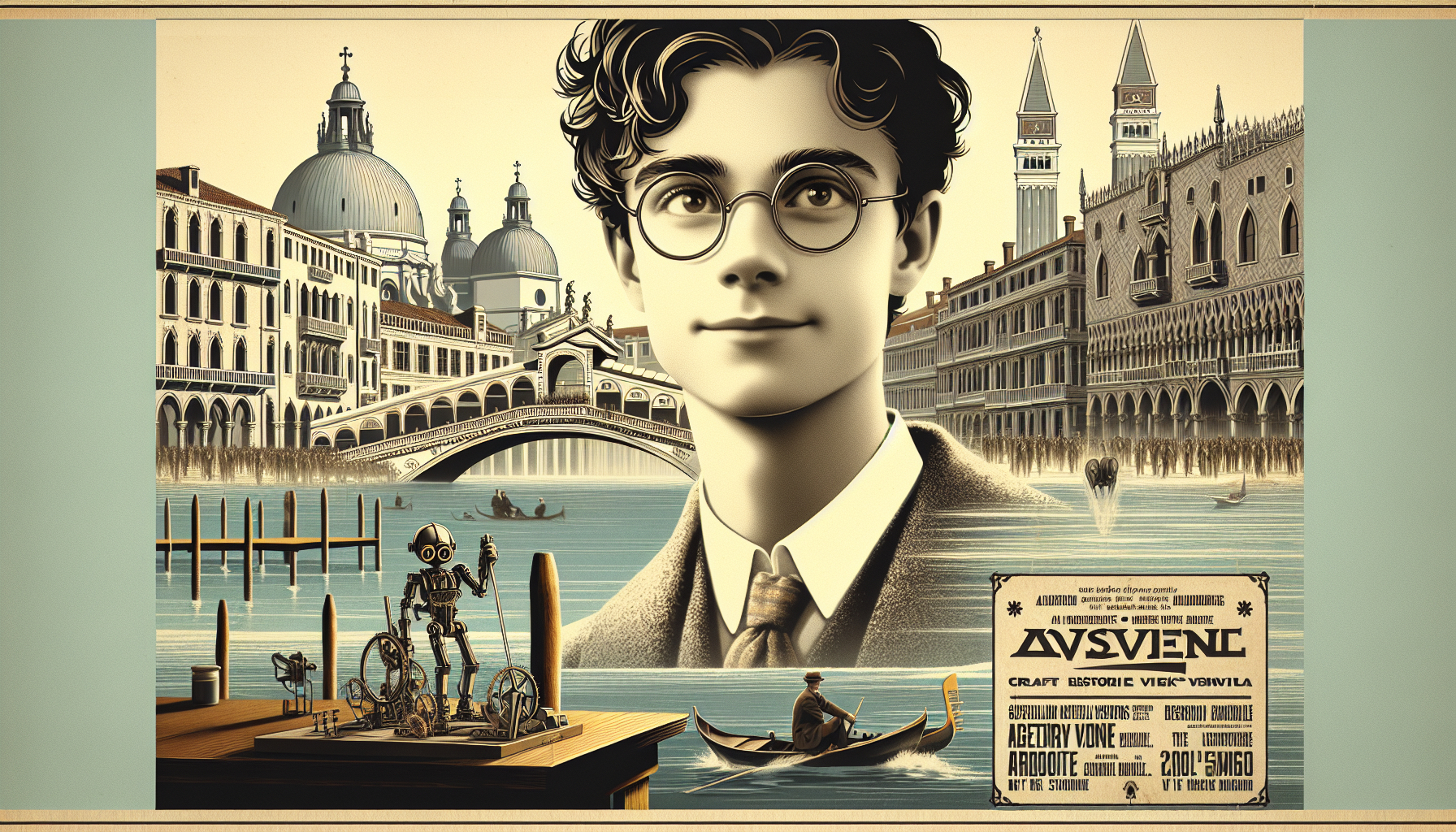
Since childhood, the lagoon had spoken to me in its own language: a liquid whisper gliding beneath the surface, a subtle breath shimmering among restless reflections. New Venice was far more than a fleeting stop for shutter-clicking tourists; it was a living soul, a delicate balance striving to endure as the world spun recklessly onward.
My name is Arlen, 24 years old, and though I prefer to think of myself as an inventor rather than a mere city dweller, I was born here—in the heart of this labyrinth of canals and secrets.
My workshop hid away in a quiet alley near the Rialto Bridge. Surrounded by blueprints, gears, and copper pipes, I dreamed of ideas that might save our lagoon: floating filters to catch drifting debris, devices harnessing currents to generate clean energy, water quality sensors… Yet all of it felt insignificant beside the vastness of the city and its millennia of history.
One evening, I decided to step out, carrying my latest prototype with me. I made my way toward St. Mark’s Square beneath the emerging twilight. The golden glow of the fading day lit the basilica’s mosaics, whose domes and arabesques seemed to guard enigmatic secrets. The crowd was a distant hum; long ago, I had learned to listen closely even amid the chaos.
I sat on a bench and carefully unfolded the device—at first glance, nothing more than a floating trunk. I had named it the Ecodolphin, for it mimicked the graceful movements of dolphins, gliding through water while filtering out microplastics without disrupting aquatic life.
As I adjusted a few cables, a curious voice spoke from behind me:
“Is that for the lagoon?”
She was a woman, a turquoise scarf wrapping her hair, eyes gleaming in the shadows—I immediately knew she was a stranger here. I nodded without looking up from my device.
“My name’s Lia,” she said. “I’m an environmental journalist, here to understand how New Venice’s people fight for their home. You’re not often this open.”
I sighed, realizing I wouldn’t be retreating into my inventor’s shell that day.
“It’s more than a fight,” I said. “It’s a dialogue with these waters. The lagoon has a memory. We must listen before disturbing its rhythm.”
Lia smiled, as if struck by an unexpected clarity, then offered something surprising: to test the invention together on a quieter canal, away from the chaos and gilded gondolas.
Before the evening bell tolled its final note, we boarded a small boat, gliding through canals where stone walls mirrored a faded sky. My heart beat louder than the rowers’ echoes.
I placed the Ecodolphin on the water, and to my astonishment, it came alive with fluid motion. Around us, currents slowed, particles of pollution drawn toward invisible filters. Then the unexpected happened.
Suddenly, at the moment the machine reached peak efficiency, a flock of birds appeared overhead, forming a perfect circle. Seagulls hovered motionless in the air, as if paying tribute to this fleeting moment.
“I’ve never seen anything like this,” Lia whispered, camera in hand. “Maybe New Venice is adapting to a change. A change we can’t measure with technology alone, but one we feel on our skin, in the breath of the wind.”
I glanced toward the Rialto Bridge glowing in the distance and felt that our small acts, set against this timeless backdrop humming with whispers, carried a new weight. Between art and water, the ancient and the uncertain, I had found a reason to exist beyond plans and cold logic.
New Venice didn’t need heroes or image-hungry tourists. It needed witnesses and lovers ready to heed the eternal dialogue flowing through its watery streets. And perhaps, just perhaps, that would be enough—to safeguard the faithful reflection of the future within this lagoon that never sleeps.
Note: This story is a work of fiction. The places mentioned do exist and can be visited.


